

How to Find the Keywords that Most of the Top Competitors are Sleeping on
For a full walk through on how to do this strategy, watch the video below:
Let’s talk about keywords.
No, not the obvious ones that every seller and their dog are fighting over on Amazon. I’m talking about the sneaky, overlooked, underdog keywords—the ones your top competitors are totally sleeping on… and the ones that could be quietly putting money in your pocket.
Sound good? Cool. Grab a coffee (or a coffin shelf—more on that later), and let’s get into it.
Why Should You Care About “Hidden” Keywords?
We all know the importance of ranking for the top keywords in your niche. If you're selling coffin shelves, of course you want to rank for “coffin shelf.” That’s a no-brainer. All the top competitors are fighting for those top spots, and honestly, you should be too. Those keywords are valuable for a reason.
But here’s where things get interesting: what about the keywords that only one or two competitors are ranking for… yet they’re still getting sales?
That’s what we call opportunity.
These hidden gems might not have the search volume or the competition of your main keywords—but that’s exactly the point. Less competition means you’re not stuck in a keyword cage match with seven other listings. You're just casually sliding into a customer’s search results with minimal effort.
Let’s take “gothic decor” as an example. At first glance, you might not think it applies to a coffin shelf. But here’s the thing: some buyers don’t call it a coffin shelf. They search using terms like “gothic decor” because they’re looking for a vibe, not a product title.
So if you’re one of the only coffin shelf listings showing up for “gothic decor”? You’ve got a 50/50 shot—or maybe even a 100% shot—of getting that sale. That’s the magic.
How Do You Find These Secret Keywords?
Enter: Cerebro.
Let’s say you’ve already run a multi-ASIN search and gathered data on your competitors. Instead of focusing only on the top-performing keywords, click that little magic button called “Opportunity Keywords.”
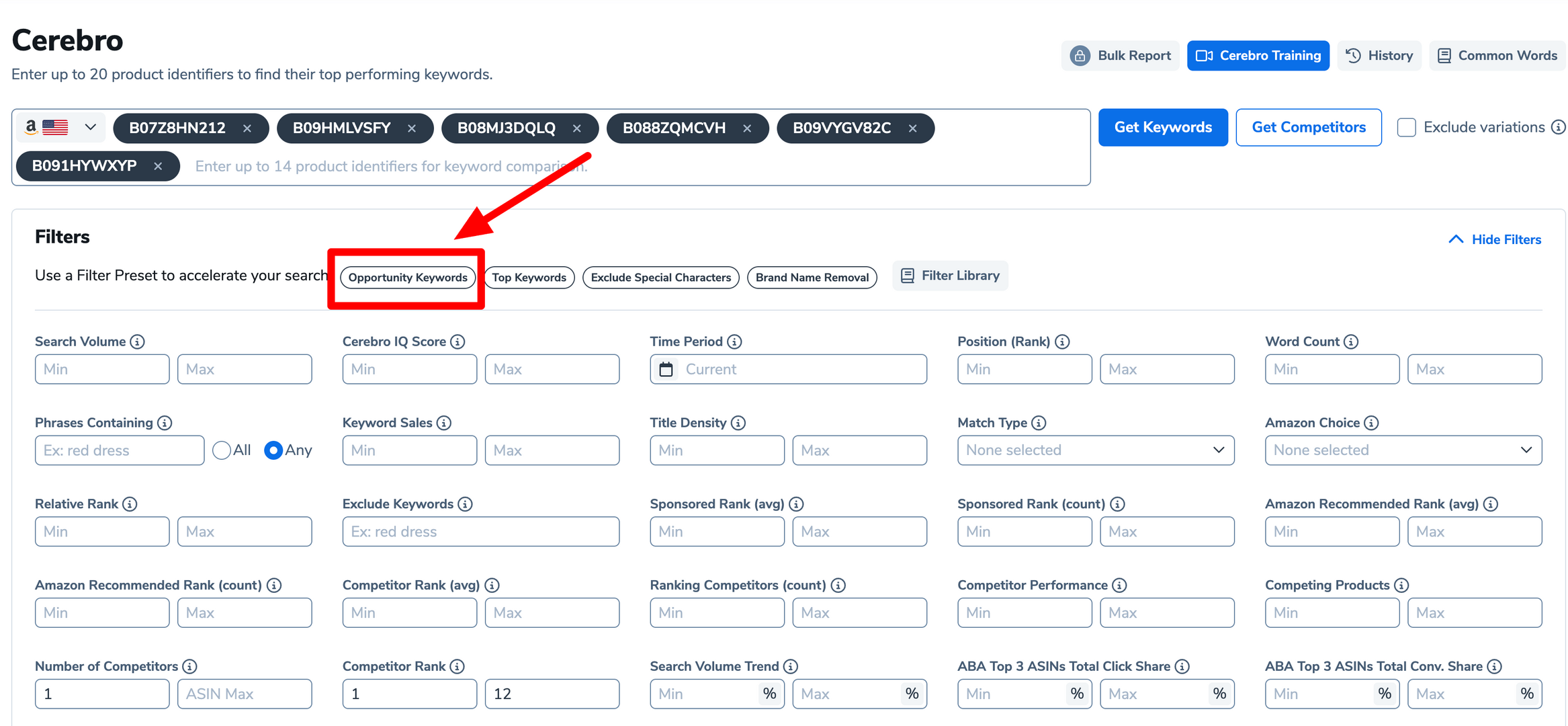
What does it do? It applies filters to surface keywords where a maximum of five competitors are ranked—and where only one competitor is ranking in the top 15. Translation: these are keywords where only one seller is showing up near the top, and the rest? Nowhere in sight.
Here’s what that looks like in action: I ran this on a coffin shelf niche, and boom—12 keywords popped up. One of them was “gothic shelf.” Only one competitor was ranked #13 for it. The rest? One was in position 16, another at 76, 77, and 96. Hardly a threat.
So if I can crack the top 10 for “gothic shelf,” guess who’s suddenly dominating that page? Yep—me.
Want to Get Nerdy With It? Customize Your Filters
You’re not limited to the default settings. Play around with those filters like a kid with a new toy.
For example, try this:
- Set your Number of Competitors to a minimum of 1 (you want at least one ASIN showing some activity on a keyword).
- Under Competitor Rank, set the range to 1–10 (you’re looking for keywords where someone is ranked at the top).
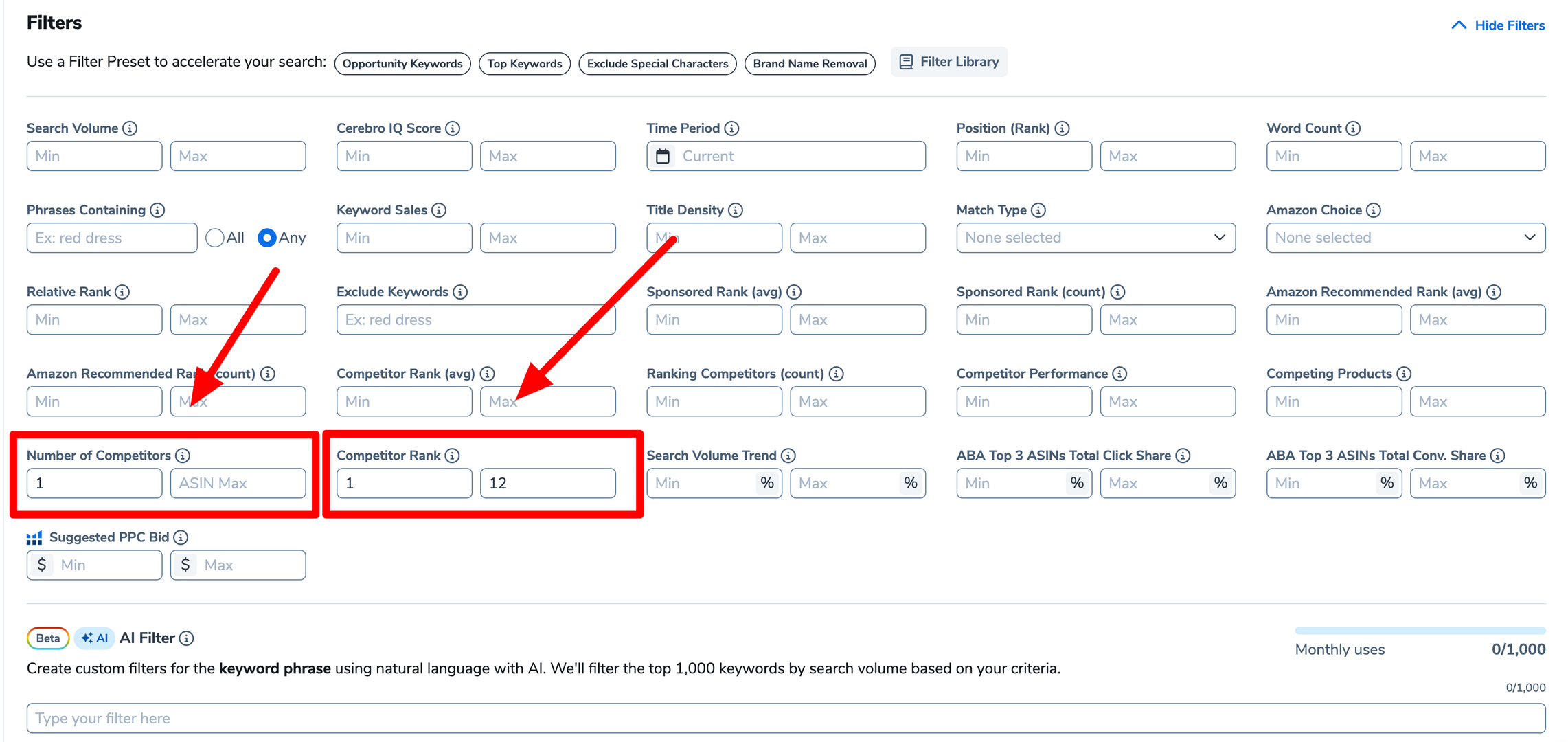
This will show you all the keywords where any one of your selected competitors is sitting pretty in the top 10. I did this and found 83 keywords. Not bad, right?
This kind of filtering lets you dig into the data and surface keywords that are relevant, proven, and not yet overcrowded. It’s like keyword gold panning… but way less messy.
Why This Strategy Works
Most sellers chase the obvious keywords. That’s great for visibility, but it also means you're constantly battling other listings, aggressive PPC bids, and shifting ranks.
These lesser-known keywords? They’re your quiet opportunity to win customers who are thinking outside the box—or in this case, outside the exact keyword.
And the best part? Your competitors probably aren’t even paying attention.
If you can collect these hidden gems across your top 10 or 15 competitors, add them to your listing (and backend), and start showing up on page one for them, you're setting yourself up to snag those off-the-beaten-path sales.
Final Thoughts
There’s no single “perfect” keyword strategy. What works for one seller might not work for another. That’s why Helium 10 gives you filters—to explore, experiment, and get insights your competition isn’t even thinking about.
So go ahead, hit that “Opportunity Keywords” button. Play around with your filters. And remember: sometimes the best keywords aren’t the loudest—they’re the ones hiding in plain sight.