

Helium 10 Blackbox: How to Research a Brand's or Seller's Top Products
For a full walkthrough of this strategy, watch the video below:
Let’s be real—we’ve all done it.
You’re scrolling through Amazon, minding your own business, when you land on a competitor’s listing that looks oddly familiar. Maybe the branding is eerily similar. Maybe you’re 90% sure they use the same supplier as you. Or maybe your inner eComm detective just can’t help itself.
Whatever the case, you suddenly need to know everything they’re selling. Not out of spite—but because if their other products are performing well, maybe there’s a golden idea in there for you, too.
And guess what? There’s a totally non-creepy way to find out.
So, Why Should You Care What They're Selling?
Whether you're running a private label brand or working the wholesale angle, spying on your competitors is just good business. Think of it as market research with a little side of sass.
When you peek at their product lineup, you’re doing more than just being nosy. You’re discovering potential product opportunities you might’ve missed, seeing what kinds of trends are emerging in your niche, and even figuring out what kinds of bundles or accessories are working. Sometimes it’s not about launching a brand new idea—it’s about executing a proven one just a little better.
And if your competitor is pulling in thousands of units a month on something like... a moon-shaped shelf? That’s worth a closer look.
How to Uncover Their Entire Product Line (Without Breaking a Sweat)
Here’s the play-by-play. Let’s say you’re selling something ultra-niche like a coffin shelf. You find another seller crushing it in your category and think, “If they can sell spooky home decor, maybe I can expand my lineup too.”
Step one: copy their seller name or brand name exactly as it appears on Amazon. Yes, capitalization and spacing matter here—no shortcuts. Then, head over to Helium 10 Black Box and make sure you are on the “Products” tab. Paste the name into either the "exact seller" or "brand" search, depending on which one you grabbed, and hit search.
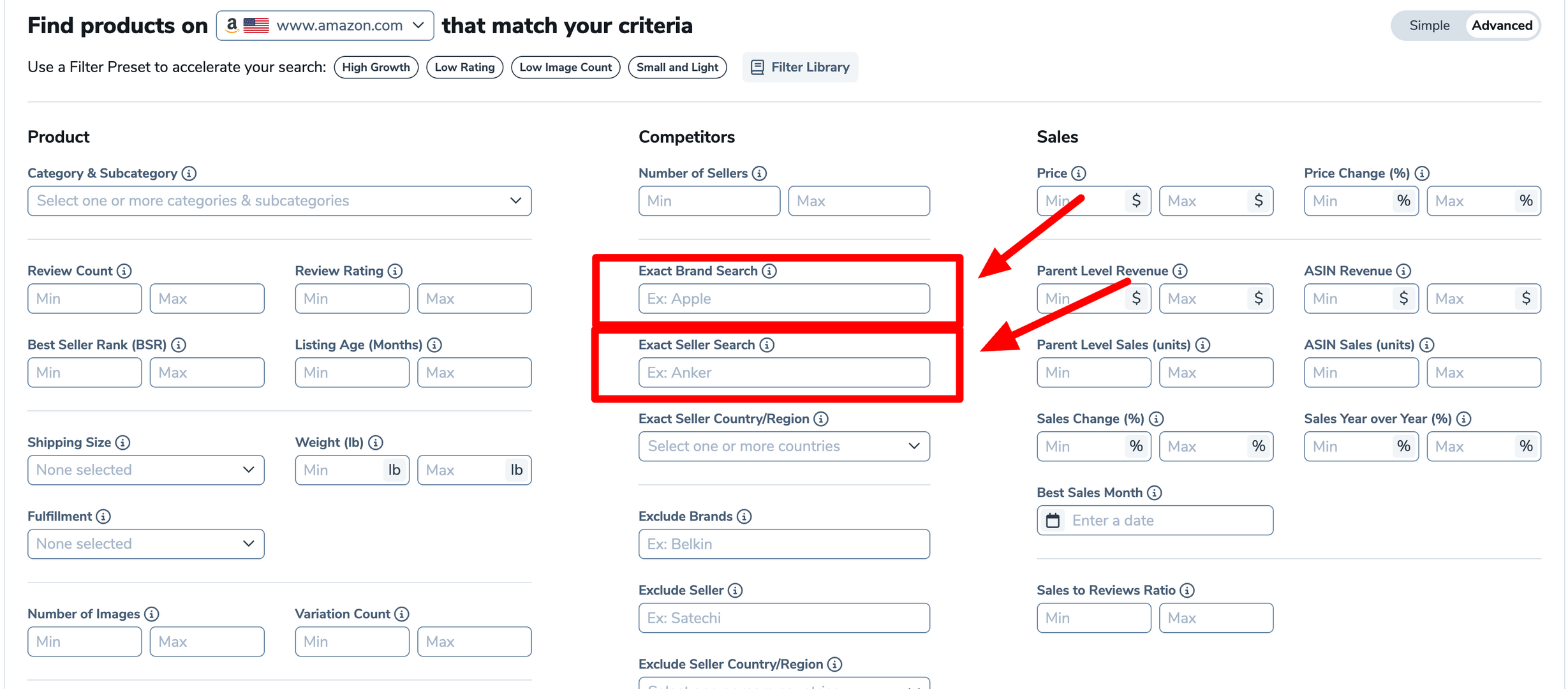
Like magic, their product catalog appears.
Now, in my case, the seller I looked into wasn’t just selling coffin shelves. They had cupcake stands. Rustic wooden crates. A moon shelf (which I lowkey loved). Even a remote control holder. Super random? Sure. But it gave me a crystal-clear picture of the kind of customer they’re targeting—and ideas for how I could expand my brand to match that vibe.
And that moon shelf? It fit perfectly into the same aesthetic I was already targeting, just with a fresh twist.
Refining the Search: Filters Are the Secret Sauce
One of the best things about Black Box is that you don’t have to scroll through pages of irrelevant info. You can apply filters that make the search incredibly specific.
Want to only see their newest product launches? You can do that. Curious about which items are selling over 1,000 units a month? There’s a filter for that, too.
This lets you go beyond just “what do they sell?” and dive into “what’s actually working for them right now?” Which, honestly, is the kind of insight that saves you time, money, and a whole lot of second-guessing.

This is actually really useful. Simple, practical and the kind of insight that can spark solid product ideas fast.

Hola buenos días, muy útil la información pero una pregunta que diferencia hay entre poner el nombre de la marca de tu competidor en black box para ver que productos vende a meterse dentro de Amazon y pinchar en la pagina del Vendedor ?
Un saludo y muchas gracias.